
September fifteenth always reminds me of Tsukimi, Japan’s mid-autumn festival. Tsukimi, which means “moon-viewing,” is traditionally celebrated on the fifteenth night of the eighth month in the lunar calendar—around September in the Gregorian calendar. It’s a time to appreciate the beauty of the full moon, often seen as a symbol of a bountiful harvest.
Origin and History
Tsukimi traces its roots back to the Heian period (794-1185 AD), when the Japanese aristocracy adopted aspects of the Chinese Mid-Autumn Festival. The Chinese festival, also centered around moon-viewing, was held to honor their moon goddess and give thanks for a successful harvest.
Over time, Tsukimi evolved into a unique Japanese tradition, blending Chinese customs with indigenous beliefs. One of the most iconic symbols of Tsukimi is the image of a rabbit pounding mochi (rice cakes) on the moon, a reference to the Legend of the Moon Rabbit.

In this tale, a compassionate rabbit offers to prepare a meal for a hungry old man. However, before the meal is ready, the old man reveals himself to be the moon god. As a reward for the rabbit’s kindness, the moon god places the rabbit on the moon, where it can be seen pounding mochi for eternity. Personally, I think the rabbit got the short end of the stick on that one!
For those unfamiliar, the moon god in both Japanese mythology and Shinto is Tsukuyomi-no-Mikoto, who also presides over the harvest. Interestingly, Tsukuyomi doesn’t feature prominently in myths or Shinto worship, making his role less widely known.
The Moon and Kaguya Hime
While the Legend of the Moon Rabbit is closely associated with Tsukimi, when I think of the moon, the story of Kaguya Hime comes to mind more than Tsukuyomi-no-Mikoto and his mochi-pounding rabbit. I imagine the same goes for many Japanese people, since the moon is more often linked to femininity and beauty than to rabbits.
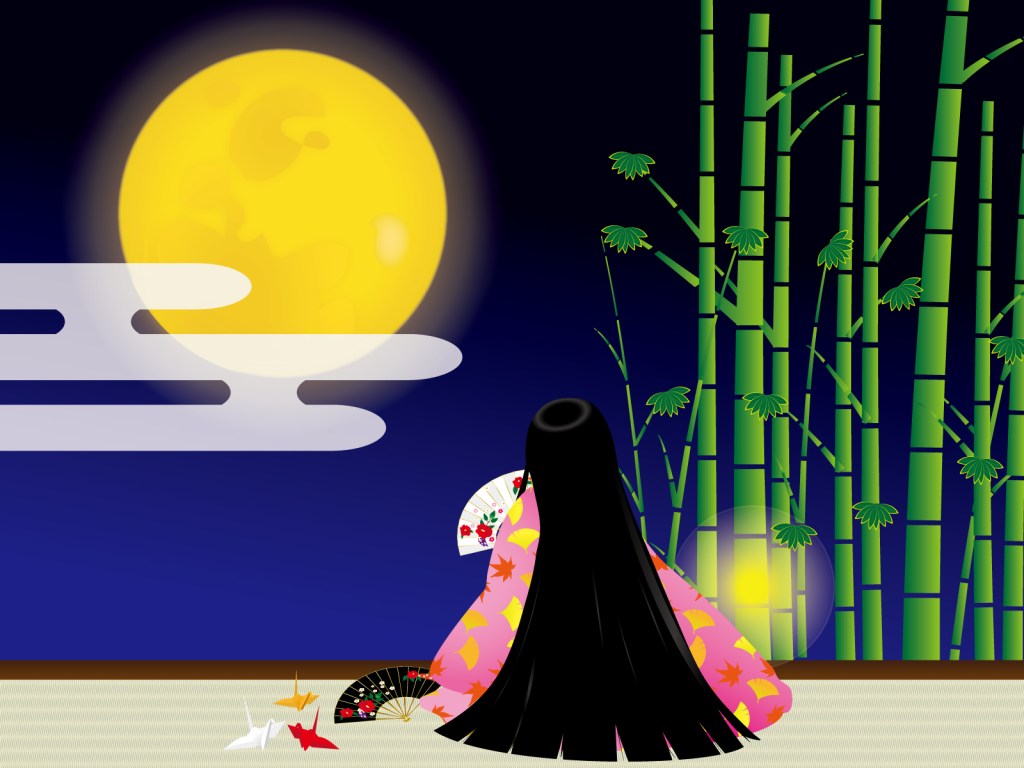
For those unfamiliar with The Tale of the Bamboo Cutter, it’s a beloved Japanese folktale about Kaguya Hime, a princess from the moon. Discovered as a baby inside a glowing bamboo stalk, she grows up on Earth and captivates many suitors. Eventually, Kaguya Hime returns to her celestial home, leaving behind a sense of longing and beauty—sentiments that are often associated with the moon in Japanese culture.
Traditional Practices
Tsukimi celebrations typically involve:
Moon-viewing: The main activity is simply gazing at the full moon, often while enjoying poetry or music.

Offerings: Traditional offerings include susuki (pampas grass), believed to attract the moon, and tsukimi dango—small spherical rice cakes. This tradition is thought to have started in the Edo period, with the dango often stacked in a pyramid to symbolize the moon high above and the rabbits pounding away on the moon.
Decorations: Homes and gardens are adorned with susuki, lanterns, and other traditional items to set the festive mood.
Modern Adaptations
Though the core of Tsukimi remains largely unchanged, the festival has adapted to modern times. I’ve noticed that not many young people, like myself, actively celebrate it anymore. Instead, it’s become more of a nod to tradition, seen in subtle ways through popular media and commercial tie-ins.
Commercialization
The commercialization of Tsukimi is especially visible in the food and beverage industry. Many restaurants and cafes introduce limited-edition products inspired by the festival, such as themed snacks, drinks, and desserts.
Perhaps the most iconic example is McDonald’s limited-edition Tsukimi burger. Much like the McRib or Shamrock Shake, fans flock to McDonald’s when it reappears each season. The burger consists of a beef patty, bacon, a fried egg (symbolizing the full moon), and creamy tomato sauce. Different versions of the burger sometimes include cheese or even a breakfast sandwich variation. The TV commercials for it are just as memorable—this year’s ad even cleverly weaves in the Kaguya Hime legend!
Check out this year’s McDonald’s Tsukimi burger commercial here.
In the end
Tsukimi, or “moon-viewing,” is a traditional Japanese festival with roots in Heian-period customs. It celebrates the beauty of the full moon with offerings of susuki grass and tsukimi dango. Although the festival originally drew from Chinese traditions, it has evolved into a uniquely Japanese practice, blending mythology and harvest rituals.
While Tsukimi has adapted to the modern era—through things like McDonald’s Tsukimi burger—it remains a meaningful occasion, connecting Japan’s past with its present. Whether through traditional observances or modern marketing, Tsukimi continues to celebrate the moon’s enduring beauty and its cultural significance in Japan.
Maybe this year, on September seventeenth, when the moon is full, we can take a moment and appreciate the beauty of the moon and the bounty that the season provide us in harvest.
 Miles from Home
Leave a comment