Happy New Year to those who stumbled upon this blog. I cannot believe I’ve had this blog up and running for a full year now. Although I haven’t been able to share as much as I wanted to when I initially started up the blog, I’m thankful for all of those who have subscribed and or read any of my posts!
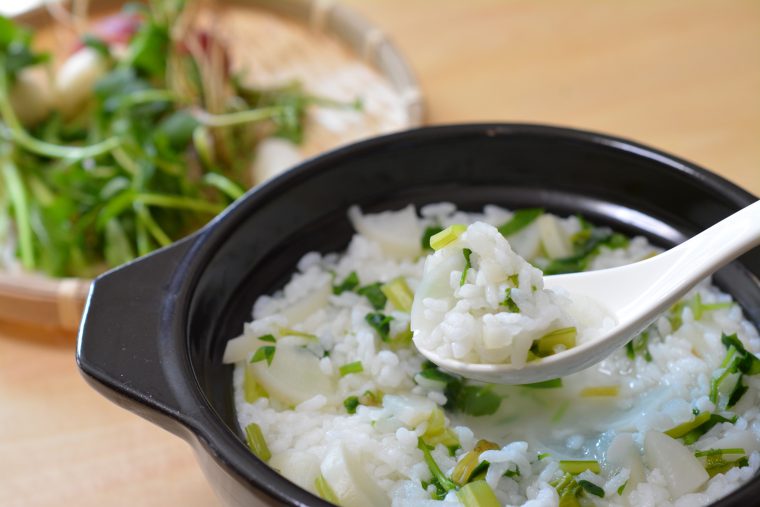
Since the hustle and bustle of the New Year celebrations are coming to a cease as people returned to their workplaces on Monday, I decided to highlight Japanese New Years from a different angle– I want to tell you all about Nanakusa gayu (七草粥), also known as “seven-herb rice porridge.”
It’s not a very long read, but here’s a button for your convenience.
What is Nanakusa Gayu?
Nanakusa gayu is a rice porridge traditionally enjoyed on January 7th, known as “Jinjitsu” (人日) or “People’s Day.” The dish is made with seven specific herbs of spring hence the name nanakusa:
- Seri (せり, Japanese parsley)
- It is expected to have antipyretic, stomach-strengthening, intestinal regulation, diuretic, appetite-stimulating, and blood pressure-lowering effects.
- Nazuna (なずな, shepherd’s purse)
- It has diuretic, detoxifying, and hemostatic effects, and is also said to be effective for gastrointestinal disorders and swelling.
- Gogyo (ごぎょう, cudweed)
- It has an effect on throat symptoms such as phlegm and cough, and also relieves pain.
- Hakobe (はこべ, chickweed)
- This young green has been used as a medicine for abdominal pain since ancient times and is effective against gastritis. In fact, it is also effective against pyorrhea.
- Hotokenoza (ほとけのざ, henbit)
- It has the effect of keeping the stomach healthy, increases appetite, and is even effective against toothache.
- Suzuna (すずな, turnip greens)
- It also has the effect of keeping the stomach healthy and promoting digestion. It is also effective against chilblains and freckles.
- Suzushiro (すずしろ, daikon radish greens)
- The nutrients in daikon radish are expected to prevent colds and beautify the skin.
These herbs are mixed into a lightly salted porridge made from white rice, creating a dish that is as nourishing as it is symbolic.
The Meaning Behind the Dish
Eating nanakusa gayu is believed to:
- Cleanse the body: After indulgent New Year’s feasts, the light and simple porridge is a way to give your digestive system a break.
- Invite good health: The seven herbs, known for their medicinal properties, are thought to ward off illness and ensure vitality in the coming year.
- Connect with nature: The inclusion of seasonal greens ties this tradition to the rhythms of the natural world.
A Brief History
The practice of eating nanakusa gayu dates back over a thousand years to the Heian period (794–1185). Inspired by Chinese customs, of eating thicker broths with Seven vegetables. These seven veggies were different from what is listed above. It is often said that it contained rice, assortment of millet, sesame, and adzuki beans instead.
Prior to the Chinese customs coming into Japan, people of Japan had a winter time custom of picking fresh greens peeking out of snow. This custom was called Wakakusa tsumi. I’m not sure which herbs were trimmed at the time, but it is said that the herbs used today is what it is because it was written down sometime during the Kamakura period (1185-1333).
Making Nanakusa Gayu at Home
Recreating this tradition in your own kitchen is a wonderful way to connect with Japanese culture. If you’re outside Japan, sourcing all seven herbs might be tricky, but substitutions like parsley, spinach, fennel, or watercress can capture the spirit of the dish.
Here’s a simple recipe:
Ingredients:
- 1 cup of cooked white rice
- 4 cups of water or dashi (Japanese soup stock)
- A pinch of salt
- A handful of fresh greens (traditionally, the seven herbs of spring)
Instructions:
- Combine the cooked rice and water/dashi in a pot. Bring to a boil, then reduce heat to simmer.
- Cook gently, stirring occasionally, until the mixture reaches a creamy porridge-like consistency.
- Chop the greens into small pieces and add them to the pot. Simmer for another 2–3 minutes.
- Season lightly with salt and serve warm.
Reflections
In a fast-paced world, traditions like nanakusa gayu invite us to slow down and embrace simplicity. Beyond its health benefits, this humble dish offers a moment to reflect on the year ahead and appreciate the interconnectedness of food, culture, and nature.
Have you tried nanakusa gayu before, or do you have a similar tradition in your culture? Let me know in the comments below—I’d love to hear your thoughts!
 Miles from Home
Leave a comment