For starters, I already know what my 2026 New Year’s resolution is going to be: to write more for my blog.
How are we all doing?
As I adjust to my new life back in Japan, it sometimes feels like time is sprinting ahead of me while I’m still lacing my shoes.
But today, I hopped back into my little blog world because I wanted to share what an incredible visit I had to Himeji.
Himeji, Pronounced Flat
I learned two things on my day drip to Himeji.
- My average walking speed apparently jumps to 5.8 km/h when I’m excited.
- I had been saying “Himeji” wrong this entire time.
In Japanese, intonation matters more than my pride would like to admit. And to make things worse, Kansai and Kanto have totally different “standard” pitch accents. I’d been pronouncing it with dramatic stairs in pitch Hí-me-ji as if I were performing it.
Turns out it’s flat.
No drama.
No stairs.
Just: Hi-me-ji.
I posted my confusion on Threads, and it ended up getting reviewed by multiple Kansai dialect speakers. The verdict? It’s definitely flat… and mispronouncing it seems to be one of their regional pet peeves.
Oops.
Stepping Into Himeji
From Kobe, Himeji is an easy train ride. It’s one of those “I’ll just go for the day and be back before it’s properly dark” kind of destinations.
For a little context:
Himeji sits in Hyogo Prefecture, west of Osaka and Kobe, and is home to Himeji Castle, a UNESCO World Heritage site famous because of its bright white walls and elegant silhouette.
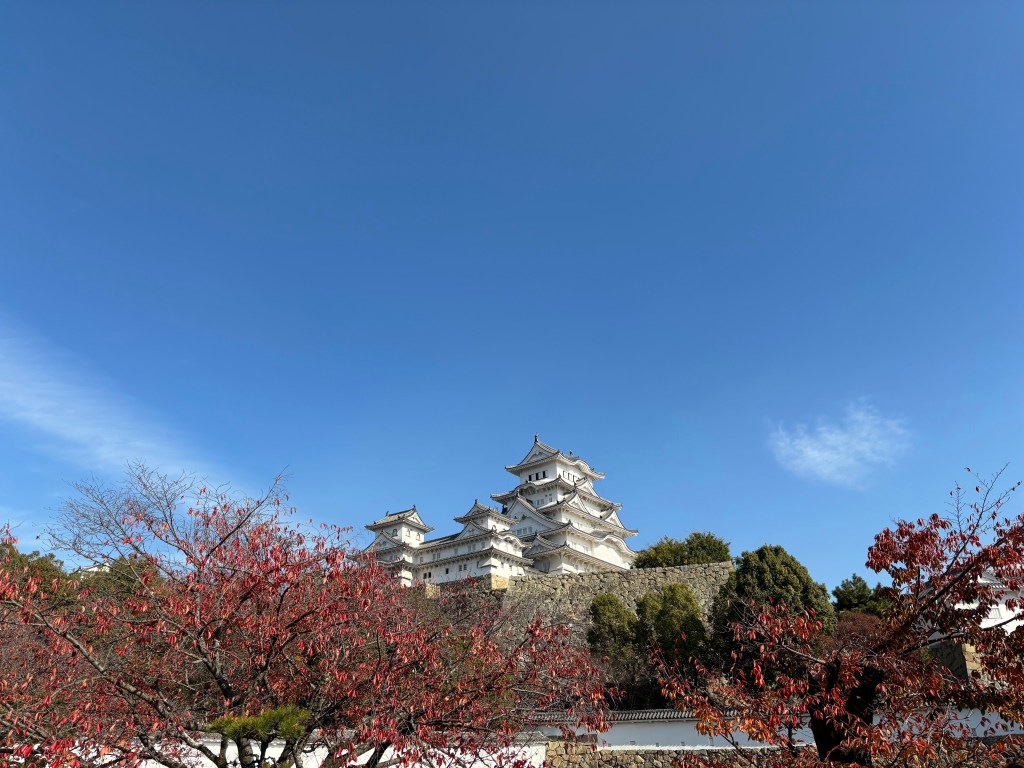
When I stepped out of the station and turned onto the long avenue toward the castle, there she was—Himeji Castle in the flesh.

There’s something almost theatrical about the way she appears: perfectly centered at the end of the boulevard, framed by traffic, trees, and everyday life. You don’t have to search for her; she reveals herself to you.
I learned as a kid that the “Edo Castle” in the old TV drama Abarenbō-Shōgun was actually Himeji Castle, and for some reason that completely rewired my tiny second-grade brain. So yes, this castle has been on my bucket list for nearly twenty years.
(Please don’t ask why samurai dramas ranked higher than cartoons for me. I can’t explain it either.)
And just so we’re clear: Himeji Castle’s real history is far deeper than its TV cameo. I promise I’m not reducing it to 1980s programming.
The Castle
By the time I reached the castle grounds, it was noon, and the entire area was buzzing in that unmistakable “famous landmark in Japan” way. Tour buses unloaded in waves, couples took turns posing with selfie sticks, older ladies in slightly fancy outfits grouped together for photos, and families with energetic kids zigzagged around the paths. If you can picture them, they were there.
Luckily, I had bought my ticket ahead of time, so I slipped inside without much waiting. (Believe me—the line for same-day tickets was long even by my standards.)
The moment I stepped inside the castle itself, the scent of old wood rose up to greet me.

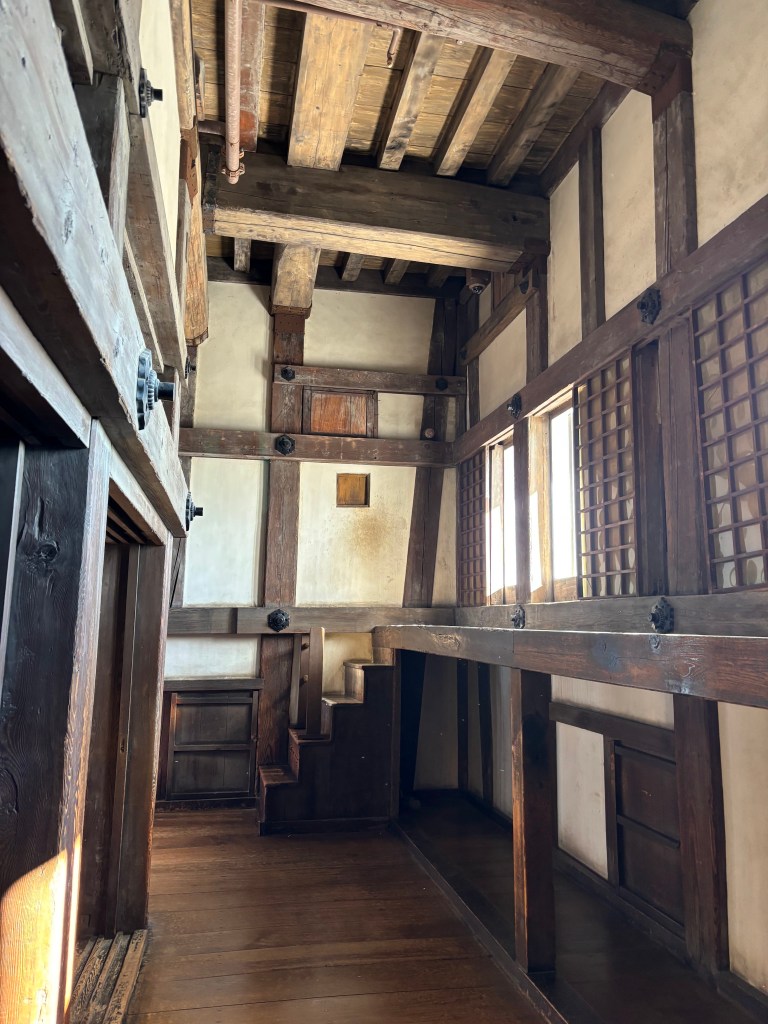
It’s a nostalgic, calming smell—warm, earthy, quiet. The floorboards were wide and worn smooth, and the beams were thick in a way that instantly reminded you that this structure wasn’t merely built; it was forged.
Climbing to the top meant navigating a series of incredibly steep wooden staircases—so steep that you start to wonder how anyone ever ran up and down them in full armor without breaking something important. Each level felt like its own pocket of preserved time, dim and cool, wrapped in the soft creak of centuries-old wood.
From the highest floor, the view opened up in every direction: modern buildings, rooftops rolling into the distance, and the neat grid of city blocks encircling this one perfectly preserved fragment of the past.
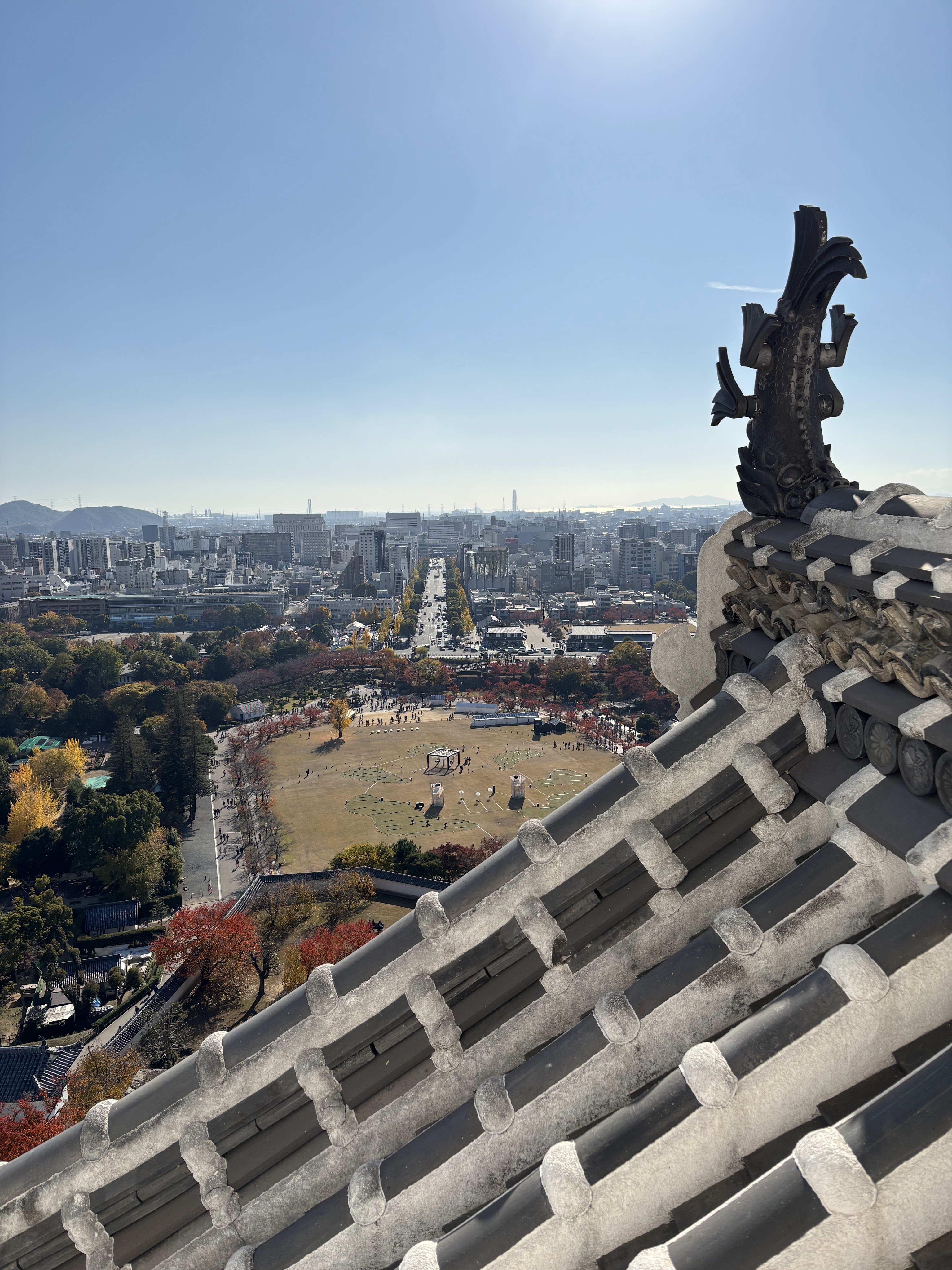
It’s the kind of place that makes you think,
“People actually lived here, in this maze of white plaster, wooden beams, and unbelievably steep stairs?”
You feel both romantic about the history and quietly grateful that elevators exist now.
Beyond the Castle Walls
After exploring the interior, I wandered around the exterior perimeter and stumbled into what was probably the moat—wide, still water lined with Japanese maples blazing in every shade from deep red to yellow-orange.
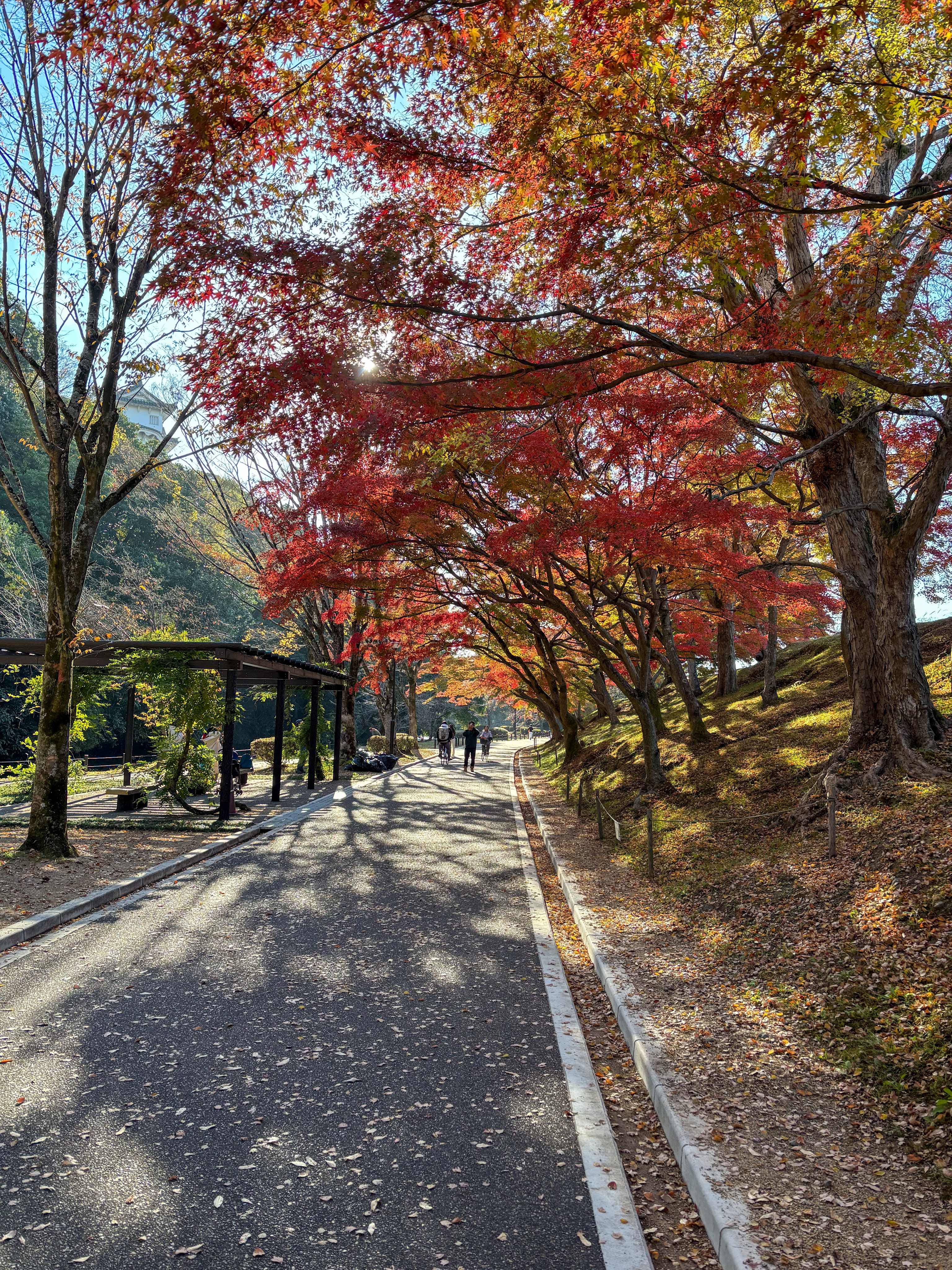
It felt like the castle had its own built-in halo of autumn. It must not be a well-known spot, because only a handful of people were there taking in the view. The air was quiet in that very Japanese way, where everyone seems to agree to collectively lower their voices out of respect for the season.
Just a short walk from the castle is the Koko-en Japanese Garden, and I’m so glad I stopped by. It’s a beautifully landscaped garden divided into several smaller themed gardens—think ponds, bamboo groves, stepping-stone paths.

And tucked inside is a tea house. Of course, as someone who practiced the art form, I had to go in.
I ordered matcha and wagashi and ended up chatting with a pair of local grandmas who told me they come for tea once a month. They were lovely—soft-spoken, funny, and genuinely curious about my height and facial features, as well as my move back to Japan. Their warmth surprised me in the best way.
It’s the kind of gentle interaction I don’t often get in Kobe, where people tend to keep a polite distance. But these two grandmas? They welcomed me into their afternoon as if we already knew each other.
After leaving the garden, I wandered through the neighborhood behind the castle, where the streets felt suburban and calm. Single-family homes, tidy gardens, the kind of quiet that makes you slow your steps without realizing it. I passed a few small museums, walked by a park where young men played soccer, ducked into a couple of shōtengai, and eventually found a shop selling Himeji-oden, a regional style of oden served with ginger soy sauce.
Conclusion
On the train ride back to Kobe, I kept replaying small moments from the day—the bright maple leaves, the quiet neighborhoods, the soft laughter of the grandmas in the tea house. None of it was dramatic, but all of it stayed with me.
Himeji didn’t overwhelm me with things to do; it simply offered me space to wander, to notice, to breathe. And in the middle of adjusting back to life in Japan, that was exactly what I needed.
I left with tired legs (I checked — 25,355 steps), a properly pronounced city name, and a little more warmth in my chest than I started with.
And honestly? That feels like a win.
I’ll be back to Hi-me-ji. Flat, of course.

 Miles from Home
Leave a comment